




If you’ve ever felt like your mind just won’t switch off — the endless loop of “what ifs,” a heart that beats faster than you’d like, a tension that never fully leaves your shoulders — you’re not alone. Anxiety has become the unwanted background music of our times.
It’s not just the big life events that set it off. It’s the constant hum of emails, the news cycle, the feeling that the world expects you to run at full speed, all the time. And while therapy and medication have their place, there’s a growing hunger for something simpler. Something natural. Something you can do quietly, in your own space, without side effects.
That’s where Transcendental Meditation — often just called TM — comes in.
“It’s the most important thing in my life,” filmmaker David Lynch says of TM. “It has given me the ability to dive within and find an ocean of calm.”


What Is Transcendental Meditation and Why It Helps Anxiety
Imagine sitting in your favorite chair, closing your eyes, and instead of wrestling with your thoughts, simply letting them drift away as your mind glides into a quieter place. That’s the essence of TM.
It’s not about trying to “empty” your mind or controlling your breath. In fact, the beauty of TM is that it’s effortless. You use a simple sound — a mantra — repeated silently in your mind. This gentle repetition allows your busy thoughts to settle, like snowflakes falling to the bottom of a snow globe.
Introduced to the world in the 1950s by Maharishi Mahesh Yogi, TM’s roots go back thousands of years in the Vedic tradition of India. Today, millions of people practice it — from stressed-out students to high-profile celebrities — because it works.
Understanding Anxiety’s Grip on the Mind
Anxiety is your body’s built-in alarm system, meant to keep you safe when there’s real danger. But modern life often tricks this system into staying switched on, even when the “threat” is nothing more than a jam-packed calendar.
The result? Racing thoughts, muscle tension, restless nights, and an underlying sense of unease. Your nervous system is stuck in “fight or flight” mode, flooding you with cortisol and adrenaline. Over time, that state becomes your new normal — and breaking free means retraining your mind and body to remember what calm feels like.
That’s exactly what TM helps you do.
“The first time I tried TM, it felt subtle — like someone turned down the volume inside my head. Over time, that quiet began to last all day.”
How Transcendental Meditation Calms Anxiety
When you practice TM, your body shifts into a state researchers call restful alertness. Breathing slows, heart rate drops, and cortisol — the main stress hormone — can fall by up to 30% (Source: NIH).
Inside your brain, alpha waves associated with relaxation become stronger, while overactive “alarm” centers in the amygdala quiet down. The prefrontal cortex — responsible for decision-making and emotional balance — becomes more active, helping you respond to challenges more calmly.
And unlike techniques that require mental effort, TM’s effects are automatic. You don’t have to force calm — it just happens as the mind naturally settles.
Scientific Studies on TM for Anxiety Relief
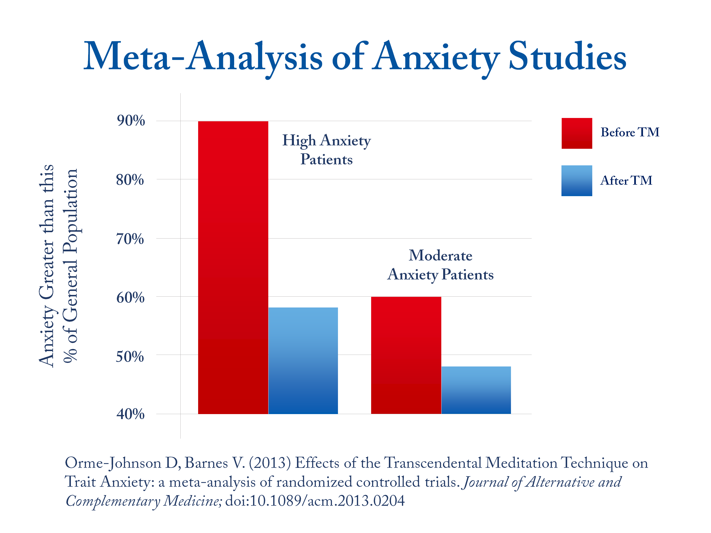
The research is compelling. A meta-analysis of 146 studies found TM to be more than twice as effective as other meditation or relaxation methods for reducing long-term anxiety (Source: American Journal of Health Promotion).
During the height of the COVID-19 pandemic, a randomized controlled trial of healthcare workers practicing TM showed rapid drops in anxiety, depression, and burnout in just two weeks (Source: Journal of Continuing Education in the Health Professions).
High school students in stressful environments saw lower anxiety, better focus, and improved emotional stability after four months of TM (Source: Contemporary School Psychology). Veterans with PTSD have also reported significant reductions in hyperarousal and anxiety symptoms (Source: Military Medicine).
“For people with high anxiety, TM can be life-changing — the higher your stress levels, the bigger the potential benefit.” — Dr. Norman Rosenthal, psychiatrist and TM researcher
What It’s Like to Practice TM for Anxiety Relief
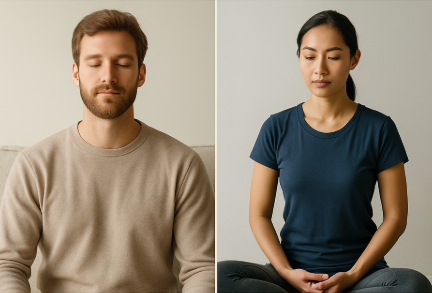
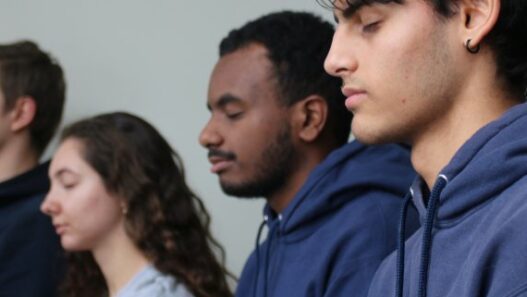
A TM session is disarmingly simple. You sit comfortably, close your eyes, and silently repeat your personal mantra. Thoughts will come and go; when you notice them, you gently return to the mantra. After about 20 minutes, you open your eyes — often feeling calmer, clearer, and more grounded.
No special posture, no chanting, no apps required. Just you, your mantra, and a willingness to be still. Most people practice twice a day — once in the morning and once in the late afternoon or early evening.
“In just 20 minutes, I can feel the tension melt away — like someone pressed a reset button.”
Comparing TM to Other Meditation Styles for Anxiety
While mindfulness meditation trains you to observe your thoughts, and breathwork uses conscious breathing to change your state, TM takes you beyond thought altogether. You’re not focusing on the present moment — you’re slipping beneath it, into a deeper, quieter mental space.
For those with anxiety, this can be easier. Concentration-heavy methods sometimes feel like more mental work; TM is effortless, which makes it accessible even when your mind feels chaotic.
Real Stories of TM and Anxiety Transformation
Katy Perry says TM keeps her balanced on tour. David Lynch funds TM programs in schools and prisons because, in his words, it “changes lives.”
I’ve spoken with a nurse who, after years of waking with a racing heart, finally slept through the night after just a few weeks of TM. Parents tell me they’re more patient with their kids. Students say they can focus in class without that constant undercurrent of worry.
These aren’t one-off miracles — they’re the kinds of changes TM has been quietly delivering for decades.
Before and After: Anxiety Symptoms With TM
| Before TM | After Regular TM Practice |
|---|---|
| Restless, racing thoughts | Mental calm and clarity |
| Tense muscles, headaches | Relaxed body, reduced tension |
| Trouble falling asleep | Deeper, more restful sleep |
| Irritability and mood swings | More balanced emotions |
| Feeling overwhelmed daily | Greater resilience and perspective |
Making TM Part of Your Everyday Life
The secret to getting the most out of TM is consistency. Treat it like brushing your teeth — something you do without question. Many start their day with TM to set a peaceful tone, and use the second session to release the day’s stress before evening.
Some pair it with a short walk, journaling, or gentle stretching. Others use it as their stand-alone sanctuary. However you fit it in, those 20 minutes become a safe space where anxiety doesn’t get to call the shots.
Things to Keep in Mind About TM for Anxiety
TM is a powerful tool, but it’s not a cure-all. If your anxiety is severe, it’s best to use it alongside therapy or medical care.
Learning TM requires certified instruction, which typically costs between $400 and $900, though scholarships and payment plans are often available. The results also vary — some feel a shift immediately; others notice changes more gradually. Patience is part of the process.
How to Get Started With Transcendental Meditation
If you’re ready to try TM, the best starting point is an official TM center, which you can find through tm.org. Many offer free introductory talks so you can decide if it’s right for you.
Your course will include one-on-one instruction, your personal mantra, and follow-up support. For veterans, students, and those in financial need, reduced rates or free programs are often available.
Final Thoughts on Transcendental Meditation for Anxiety
Anxiety feeds on overactive thinking. TM offers a gentle way to step beneath the noise, into a steady, quiet space that’s always there — you just have to access it.
It’s not about escaping life; it’s about returning to it with more clarity, ease, and resilience. If you’ve been searching for a practice that’s easy to learn, effortless to do, and proven to work, Transcendental Meditation for anxiety might just be the most transformative 20 minutes of your day.