




Norwich University in Northfield, Vermont, has a unique place in American military education. Founded in 1819, it is widely known as the nation’s oldest private military college and the birthplace of ROTC. For nearly two centuries, Norwich has trained young men and women for leadership, public service, and military responsibility. Its Corps of Cadets is built around discipline, structure, physical training, honor, and the development of character.
Against that background, the introduction of Transcendental Meditation, or TM, to Norwich cadets was unusual, even bold. Meditation was not an obvious fit for a military college culture traditionally associated with toughness, command presence, endurance, and physical readiness. Yet beginning around 2010 and 2011, Norwich became the setting for a serious experiment: could a simple twice-daily meditation technique help cadets reduce stress, improve resilience, and perhaps prepare them emotionally for the pressures of future military service?
The project began as a small pilot. Over time, it gained attention from campus leaders, researchers, military figures, the David Lynch Foundation, Vermont Public Radio, and The Boston Globe. It was sometimes described in the press as an attempt to help cadets prevent PTSD before exposure to combat. More broadly, it became a test case for whether inner calm could become part of military leadership training.
The Beginning: A New Idea at an Old Military College
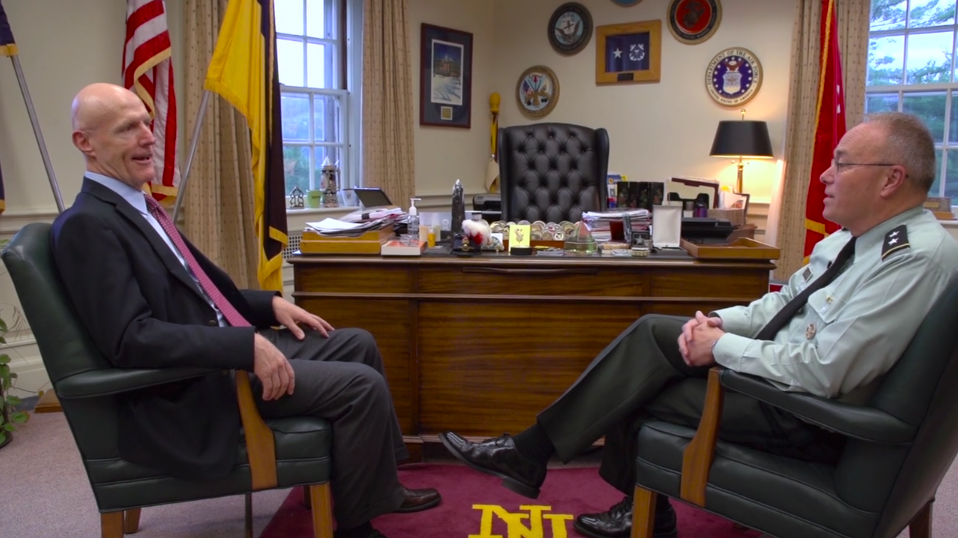
TM was first introduced to Norwich around 2010 when longtime donor and supporter Joan Andrews Prentice brought information about the practice to Norwich University President Dr. Richard W. Schneider. Schneider, a retired Coast Guard admiral, was not immediately convinced. He reportedly described himself as skeptical at first, but became more open after reviewing research and learning more about the program. A 2016 report said Schneider decided to learn TM himself, explaining the decision with the leadership principle, “You have to lead from the front.” 
This detail matters because the project did not begin as a student fad or an informal wellness club. It had support from high levels of the institution. Schneider’s involvement gave the experiment credibility in a campus culture where leadership example carries weight. If a retired admiral and university president was willing to try the technique, cadets and staff could consider it without feeling that it conflicted with Norwich’s disciplined identity.
A preliminary trial reportedly involved new students and a control group, setting the stage for a more formal project among Rooks, the first-year cadets at Norwich.
The 2011 Rook Platoon Study
Norwich had received a $40,000 grant from Foundations of America to study how to lower stress among Rooks. One Rook platoon practiced Transcendental Meditation twice a day, every day, as part of the study. Dr. Peg Meyer, director of academic achievement and educational effectiveness, was named in connection with the project.
The study focused on a highly relevant group: first-year cadets. Rookdom is demanding. New cadets face academic pressures, military discipline, physical requirements, social adjustment, and constant evaluation. Stress is not incidental to the experience; it is part of the developmental challenge. The question was whether TM could help cadets meet that challenge with more clarity and less internal strain.
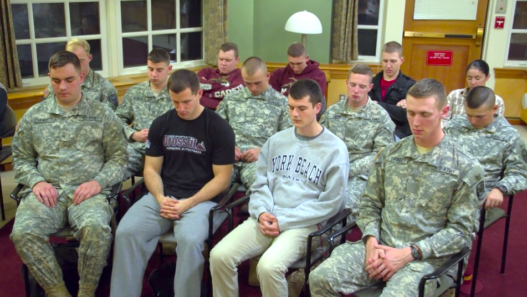
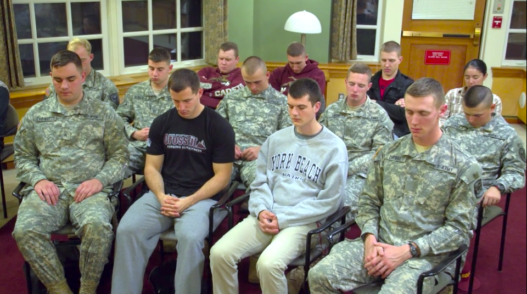
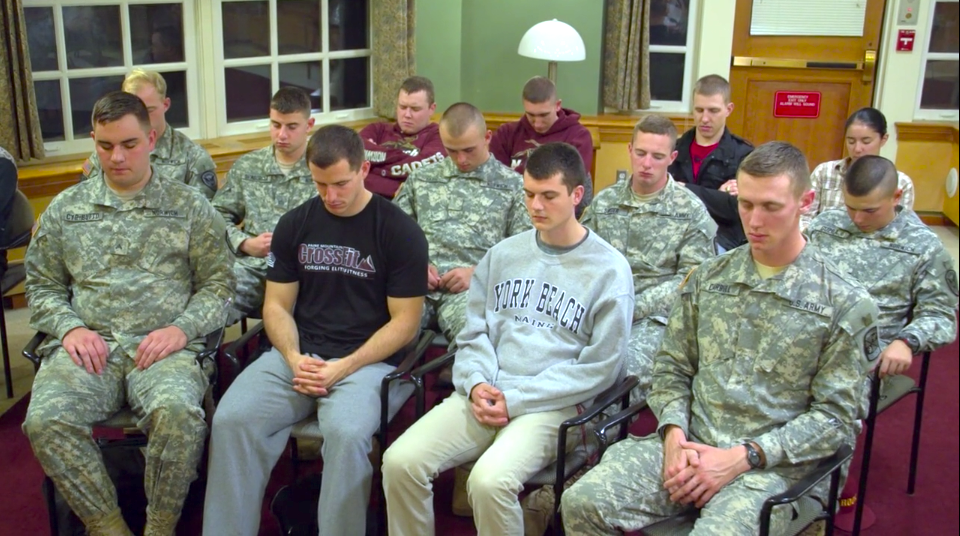
Emails were sent to Rooks in one platoon asking for volunteers. Twenty-eight Rooks volunteered. The platoon meditated at 0800 and again in the afternoon between 1620 and 1630. Cadre members were also trained and practiced with the platoon.
Cadets described feeling more focused, less stressed, more organized, and more alert in class. One freshman said he saw other students falling asleep while he felt energized and focused. Another said his stress levels were down and that his academics seemed to be “clicking.” Others said they believed the practice helped with homework, Rook knowledge, and overall energy.
These comments were anecdotal, not scientific proof. But they showed why the project gained momentum. For cadets living under intense pressure, the practice seemed to offer a practical benefit: a brief period of inner reset in the middle of a demanding day.
From Campus Experiment to Military Resilience Research
By 2012, the Norwich project had moved beyond a small campus wellness story. It became part of a larger discussion about military stress, resilience, and PTSD prevention.
Cadets said TM helped them feel calmer and better able to deal with the everyday stress of Norwich. One cadet, Ray Witkowski, said he used to feel anxious about facing cadre, upperclassmen, classes, and homework, but that practicing TM made him calmer.
The project also involved Norwich psychology professor Dr. Carole Bandy. Bandy said negative measures such as anxiety, depression, perceived stress, and bad moods decreased significantly in the TM group but not in the control group. She also said some positive growth indicators appeared after only nine weeks, earlier than she had expected.
The research was not limited to questionnaires. Cadets were also studied using brain activity monitoring. The report described cadets wearing caps fitted with wires while their brain activity was measured in response to audio stimuli and images, including stressful images. Researchers planned to compare the brain patterns of meditating cadets with a control group.
This shifted the project from a simple stress-reduction program into something more ambitious: an attempt to measure whether regular meditation could change how cadets responded physiologically and psychologically to stress.
The PTSD Prevention Question
The most powerful claim attached to the Norwich project was the possibility that TM might help prevent or reduce future combat trauma. This was not presented merely as a relaxation program. Researchers and supporters wondered whether meditation could serve as a kind of psychological preparation before cadets became officers and faced the stresses of military service.
Bandy saw the long-term potential as significant. The idea was to follow cadets into their military careers over seven or eight years to see whether TM could function as “preventative medicine” for combat stress.
This was a compelling idea because much military mental health care has historically been reactive. Service members often receive help after symptoms of PTSD, depression, substance abuse, or anxiety have already appeared. The Norwich experiment asked a different question: what if cadets could be given tools before trauma occurs?
That preventive framing made the project attractive to supporters in military and veterans’ circles. It aligned with broader conversations about resilience training, emotional fitness, suicide prevention, and the need to prepare service members not only physically, but mentally and emotionally.
National Attention from The Boston Globe
The project received major public attention in December 2012 when The Boston Globe published a feature titled “Study suggests meditation may help prevent PTSD.” The article described first-year cadets in combat fatigues and boots meditating at 0800 as part of their regimented daily routine. It called the program a long-term study to determine whether periods of silent meditation could improve performance and potentially help protect troops against acute PTSD.
The Globe noted that the study was then in its second year and that researchers were tracking participants and control groups through questionnaires, brain waves, and eye scans. Dr. Carole Bandy told the paper that measures of stress, anxiety, and depression had decreased significantly, while preliminary findings suggested improvements in critical thinking and mental resilience.
Meditation at a military college challenged assumptions about toughness. Some people reportedly joked that it was “not Norwichy.” The university chaplain expressed concerns that TM was not religiously neutral, reflecting a common criticism sometimes raised against the practice.
But the cadets themselves seemed less concerned with ideology and more interested in results. Students described feeling refreshed, lighter, less stressed, and better able to recharge. One cadet said the first reaction was that it seemed silly, but after 20 minutes, he felt refreshed. Another described feeling as if a weight had come off his chest.
The meditating platoon had faced jokes from other Rooks, including comments about “nap time.” Yet some of that ridicule reportedly faded after the group performed well in a demanding competition testing mental and physical resilience.
Support from Military Leaders
One of the reasons the Norwich TM project gained credibility was that it attracted interest from military leaders. The Globe quoted retired Brigadier General Rhonda Cornum, who had run the Army’s Comprehensive Soldier Fitness Program, as saying that becoming psychologically fit is like becoming physically fit and that it is better to do it before injury. She said she was encouraged by the Norwich study.
Retired Army Chief of Staff General Gordon R. Sullivan, a Norwich graduate and chairman of Norwich’s board of trustees, described the program as a way to help cadets handle stress “before the fact.”
President Schneider also made a strong case for the project. He pointed out that Norwich had spent nearly 200 years preparing cadets physically for military leadership, but had not spent the same kind of time preparing them emotionally for battle. He asked why such preparation should wait until after the fight.
That statement captures the heart of the project. The Norwich TM experiment was not about making military training less demanding. It was about adding an inner dimension to readiness.
The Role of the David Lynch Foundation
The David Lynch Foundation played a central role in funding and supporting the project. David Zobeck, one of the meditation instructors, worked for the foundation and was an Air Force veteran. The foundation, founded in 2005 by filmmaker David Lynch, has supported TM programs for populations dealing with trauma, including veterans and families.
The foundation’s involvement helped make the Norwich project possible, but it also means that some of the most positive accounts of the program come from TM-affiliated sources. That does not make the reports invalid, but it does mean careful readers should distinguish between independent journalism, campus reporting, promotional updates, and peer-reviewed scientific evidence.
Expansion by 2016
By 2016, the project appeared to have grown significantly. The program began with 30 cadets and had grown to about 300 TM participants at Norwich at any given time. It also said Dave Zobeck, the TM teacher who began the program, had a permanent full-time position teaching TM to cadets, faculty, and administrators.
This suggests that the initiative moved beyond its original role as a small study. It became, at least for a period, a broader campus resource available to students and university personnel.
What Can Be Said Carefully
The history of the Norwich TM project is promising, but it should be presented carefully.
It is fair to say that Norwich University hosted a donor-supported TM pilot and research project beginning around 2010–2011; that first-year cadets practiced TM twice daily as part of a stress-reduction and resilience study; that preliminary reports described reductions in stress, anxiety, depression, and negative mood; that cadets and leaders reported practical benefits; and that the project attracted national attention as a possible approach to military resilience and PTSD prevention.
It is also important to say that much of the strongest outcome language appears in preliminary reports, media accounts, and TM-affiliated sources. I did not find a widely accessible, peer-reviewed final paper specifically reporting the full long-term results of the Norwich cadet project. Therefore, the safest wording is that the project showed promising preliminary results, not that it definitively proved TM prevents PTSD in military personnel.
Why the Project Still Matters
Even with those caveats, the Norwich TM project remains important. It anticipated a larger cultural shift in how military institutions think about readiness. Today, resilience, emotional regulation, sleep, stress management, and mental health are widely recognized as essential components of performance. The idea that future officers need inner tools, not just physical conditioning and tactical training, is no longer unusual.
Norwich’s experiment was ahead of its time because it asked whether silence, rest, and self-settling could belong inside a culture of discipline and service.
For cadets, TM offered something simple: sit comfortably, close the eyes, practice the technique, and return to activity with more clarity. In the context of Rook life, that brief practice could feel like a lifeline.
For military educators, it raised a deeper question: how do we prepare leaders not only to endure stress, but to remain clear, humane, and steady in the face of it?
Conclusion
The story of Transcendental Meditation at Norwich University is the story of a quiet experiment in a demanding environment. It began with skepticism, donor support, and a small group of cadets. It grew into a visible research project involving Rooks, faculty, administrators, TM teachers, the David Lynch Foundation, and respected military leaders.
At its center was a simple but powerful idea: the mind, like the body, can be trained for resilience.
Norwich cadets were already learning discipline, honor, endurance, and leadership. TM was introduced as a way to support the inner side of those same qualities — calm under pressure, clarity in action, recovery from stress, and emotional steadiness.
The evidence should not be overstated. The long-term scientific claims require caution. But the history of the project shows that even in one of America’s oldest military colleges, there was room to explore a new form of readiness: not just stronger bodies and sharper minds, but quieter nervous systems and more resilient human beings.